
FAQs: Answering Common Questions About Modular Leasing
If you’re exploring modular building leasing for the first time or comparing your options before committing, this post covers the questions we hear most often. From cost and customization to code compliance and delivery timelines, here’s what you need to know about modular office rental and commercial modular building solutions.
What is the difference between leasing and buying a modular building?
Leasing a modular building gives you access to a fully functional structure for a defined period without the upfront capital commitment of purchasing. When you buy, you own the asset outright which makes sense for permanent, long-term installations where the building will stay on-site indefinitely. When you lease, you pay for the time you actually need the space, preserve cash flow, and avoid the cost and complexity of remarketing or storing the building when the project ends. For organizations managing enrollment surges, construction phases, emergency deployments, or seasonal demand, a modular building lease typically delivers better financial flexibility than ownership. Carter Leasing Solutions offers both lease and purchase options so you can structure the arrangement around your actual operational needs.
How long does it take to lease a modular building?
The timeline from initial inquiry to a signed modular building lease agreement is typically one to two weeks for standard configurations from existing inventory. That timeline covers the initial conversation, site assessment, building selection, lease structuring, and delivery scheduling. If customization or permitting is involved, add additional time depending on your jurisdiction and the scope of modifications. Our live inventory system shows real-time availability, which significantly reduces the back-and-forth that can slow down the process. For urgent situations such as emergency response, storm recovery, or fast-moving construction timelines we can often compress the process further with the right inventory and site conditions in place.
How much does it cost to lease a modular office?
The cost of a modular office rental depends on building size, configuration, lease duration, site conditions, and delivery distance. A small single-wide portable office building rental will carry a different monthly rate than a multi-module commercial modular building complex. In addition to the base lease rate, total project cost typically includes delivery and setup, any site preparation needed, utility connections, and optional customizations. Longer lease terms generally lower the monthly rate. The best way to get accurate pricing is to share your square footage needs, location, and timeline and we provide detailed proposals with no obligation.
Can modular buildings be customized before leasing?
Yes, leased modular buildings can be customized with a range of layout configurations, interior finishes, and functional specifications. Standard options include open office plans, private offices, restrooms, ADA-compliant entries, climate control, and branded exterior finishes. More extensive modifications such as custom floor plans, specialized mechanical systems, or unique exterior treatments are available depending on the building and lease term. Customization scope and cost are worked out during the pre-lease planning phase so there are no surprises on delivery day. Our team’s background in modular construction means we can identify what’s feasible early and advise on the most practical path to the layout you need.
What industries use modular building leasing?
Modular building leasing is used across construction, education, government, emergency response, retail and hospitality, and commercial sectors. Construction and industrial firms lease portable office buildings and workforce housing to support crews on active job sites. Schools and training programs use modular classroom rental for enrollment growth, renovation swing space, and program expansion, particularly in high-growth states like Florida. Government agencies and public sector organizations lease temporary modular offices for field operations, community services, and disaster recovery. Emergency response teams use rapidly deployable modular buildings as command centers, staging areas, and mobile clinics. Retailers and hospitality operators use modular structures for seasonal expansion and pop-up locations. The common thread across all these industries is the need for speed, flexibility, and cost-effective space without the delays of traditional construction.
Are leased modular buildings code compliant and ADA accessible?
Every modular building in our inventory is code compliant and ADA accessible. This is not optional, and it is built into the design from the beginning rather than treated as an afterthought. Buildings meet applicable state and federal building codes covering structural integrity, energy efficiency, fire and life safety, and accessibility. ADA-compliant modular buildings include accessible entries, appropriate door widths, restroom configurations, and path-of-travel accommodations where required. Our team’s 130+ years of combined experience in modular construction means code compliance issues are identified and resolved before the building arrives on your site, not during inspection. If your project has specific code or accessibility requirements, share them early in the planning conversation so we can confirm the right configuration.
How do you set up a leased modular building on site?
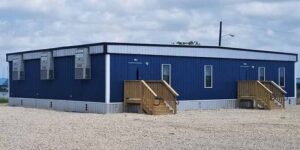
Setting up a leased modular building involves site preparation, delivery, craning or placement, utility connections, and final inspection, all of which we coordinate as part of our turnkey modular building service. Before delivery, we align on site conditions including foundation type, crane access, utilities routing, and any permit requirements. On installation day, the building is delivered and placed using appropriate equipment, modules are connected if applicable, and utility hookups are completed. Our team manages the sequencing to minimize site disruption and get you to occupancy as quickly as possible. Modular building delivery and setup timelines vary by site complexity, but straightforward installations can often reach occupancy within days of the building arriving on site.
What is included in a modular building lease agreement?
A modular building lease agreement covers the lease term, monthly rate, building specifications, delivery and setup responsibilities, return conditions, and any agreed-upon customizations or services. Modular building lease terms typically define who is responsible for site preparation, utility connections, maintenance during the lease period, and the return process at the end of the term. The agreement also outlines what constitutes acceptable use and condition of the building. We structure lease terms to be clear and practical. Before you sign, we walk through the agreement so you understand exactly what you’re getting and what’s expected on both sides.
How quickly can a modular building be delivered?
A modular building can typically be delivered within one to four weeks of a signed lease agreement, depending on inventory availability, site readiness, delivery distance, and any required permits. For projects where existing inventory matches your specifications and the site is prepared, delivery timelines can be compressed significantly. Our live inventory system provides real-time visibility into what’s available and where, which helps eliminate delays caused by availability uncertainty. Emergency or disaster response situations may qualify for expedited handling. The single most effective thing you can do to accelerate delivery is to have your site assessment, permit pre-application, and utility coordination started before the lease is signed.
Can I lease a modular classroom in Florida?
Yes, Carter Leasing Solutions provides modular classroom rental in Florida for K–12 schools, charter programs, universities, and workforce training facilities. Florida’s combination of strong enrollment growth, storm recovery needs, and active construction cycles makes modular classroom leasing a practical and frequently used solution across the state. Our buildings meet Florida Building Code requirements and are configured for the state’s specific climate and energy standards. Modular classrooms can be deployed as standalone units or as part of multi-classroom complexes using our C-Plex systems, which are approved in 17 states including Florida. If you’re facing a capacity deadline tied to an enrollment projection, a renovation schedule, or a storm recovery timeline, reach out with your location and timeline and we can tell you quickly what’s available and what’s realistic.
Do I need a permit to install a leased modular building?
In most cases, yes, installing a leased modular building requires one or more permits, though the specific requirements vary by state, county, and municipality. Permits commonly required include a building permit for the structure itself, electrical permits for utility connections, and plumbing permits if restrooms or kitchens are involved. Some jurisdictions have streamlined permitting for temporary or relocatable structures; others apply the same process as permanent construction. We help clients navigate this early in the planning process so permitting doesn’t become a last-minute obstacle. Engaging your local building department during the site assessment phase rather than after the lease is signed is the most reliable way to avoid schedule surprises.
What happens at the end of a modular building lease?
At the end of a modular building lease, you have the option to return the building, extend the lease, or in some cases convert the lease to a purchase. The return process involves scheduling a pickup date, ensuring the building is in agreed-upon condition, and coordinating site access for removal. We handle the logistics of demobilization the same way we handle delivery, with clear communication and minimal disruption to your site. If your needs change and you want to continue using the space, lease extensions are straightforward and can often be arranged before the original term expires. If the building has become integral to your operations, a lease-to-purchase conversion may make financial sense — we can model that option alongside your renewal discussion.
Ready to Talk Through Your Project?
Whether you need a temporary modular office, a modular classroom for a fast-approaching semester, workforce housing for a remote job site, or a commercial modular building for a multi-phase project, Carter Leasing Solutions has the inventory, experience, and turnkey support to get you there faster.
Our team brings 130+ years of combined experience in modular construction and financing. We own our inventory and give you more selection and better availability than most leasing companies can offer.
Tell us your location, timeline, and space requirements and we’ll take it from there.
Request a Quote or contact us directly to start the conversation.