
What to Know Before Leasing a Modular Office for Your Jobsite This Fall
Fall is a busy window. Projects that got pushed from summer are mobilizing, new scopes are kicking off, and crews are moving fast. If you need on-site office or support space and you don’t have a plan locked in, you’re already behind.
Modular leasing is the fastest path to a functional site office, but only if you go in with the right questions. Here’s what experienced PMs and supers should think through before they sign.
Plan for Your Actual Crew Size, Not Your Optimistic One
The most common mistake is speccing space based on how many people you hope to have on site, not how many will actually be there at peak.
A single-wide office module works fine for a small field team. But once you’re running multiple subs, holding daily safety briefings, and need a dedicated space for plans and inspections, that footprint gets tight fast. Think about overlapping shift changes, how many people are in the trailer at the same time, and whether you need separate spaces for supervisors and general crew use.
For larger projects, multi-unit modular complexes let you configure specific functions. This approach scales up without putting everything in one crowded space, and it avoids the situation where your office doubles as a locker room.
When you’re sizing, ask: what’s the worst-case occupancy at any given time? Build to that, not the average.
Understand What’s Actually Included in the Lease
Not all modular leases are structured the same way. Before you sign, be clear on what you’re getting versus what you’ll need to arrange separately.
A well-structured lease should include the building itself with your chosen configuration, delivery to your site, setup and installation, utility connection points, and ongoing support if something needs attention. Electrical, HVAC, and basic interior finishes should be part of the unit — not line items you’re negotiating after the fact.
What typically falls outside the lease scope: major site work, foundation preparation, utility provider fees, off-site infrastructure upgrades, and specialty equipment like security systems or custom IT. Know this going in so your project budget reflects the full picture.
If the lease doesn’t clearly spell out what’s included in delivery and setup, ask for it in writing before you commit. Scope ambiguity at this stage turns into disputes later.
Ready to get a quote for your fall project? Tell us your location, timeline, and space requirements and we’ll get back to you fast.
Know Your Delivery and Setup Lead Times
Fall is a high-demand period for modular leasing. Projects that mobilize in September and October are all running on similar timelines. If you assume you can call this week and have a unit on site next Monday, you may be disappointed.
Realistic lead times depend on your site location, what units are available in live inventory, how complex the setup is, and whether your site is actually ready to receive a building. “Site ready” means you have a prepared pad or foundation, utility rough-ins at least in progress, and crane access confirmed.
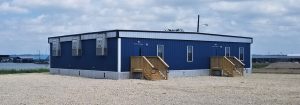
The companies with live inventory systems can move significantly faster than those working from order-to-manufacture timelines. That’s a real distinction. Ask specifically whether the unit you want is in stock and available, or if it needs to be sourced and built.
Setup day itself involves delivery, craning into position, connections to power, water, and sewer (or temporary hookups if permanent utilities aren’t ready), and basic inspection. On a straightforward site with a prepared pad, this can go quickly. Add complexity, tight access, difficult terrain, utility challenges, and you need that buffer time.
Align the Lease Term with Your Project Schedule
Most leasing companies offer short-term and long-term options. The right choice depends entirely on your schedule, and your schedule should drive the conversation, not the other way around.
If your project has a defined end date, align the lease term as closely as you can. You don’t want to be paying for months of unused space at the back end of a project, and you don’t want to be scrambling to extend if the schedule slips.
Short-term leases work well for projects with firm timelines and limited scope changes. Longer-term arrangements make sense when the project spans multiple phases, when you’re expecting scope expansion, or when pulling and re-delivering a building mid-project would cost more than simply continuing the lease through any gaps.
One thing to address upfront: what are the terms if your schedule changes? Can you extend month-to-month? Is there a penalty for early return? These are standard questions any experienced leasing provider should have clear answers.
Pre-Mobilization Checklist: What to Confirm Before You Order
Run through this before you reach out to a leasing provider. Coming in with answers to these questions shortens the process significantly.
1. Site address and access route — Can a crane truck reach the placement location? What’s the overhead clearance?
2. Pad or foundation status — Do you have a prepared surface, or will that need to be arranged?
3. Utility rough-in status — Where are the hookup points for power, water, and sewer?
4. Peak occupancy count — How many people will use the space at the same time?
5. Functions needed — Office only, or do you also need break room, restroom, or multi-unit configuration?
6. Required mobilization date — When does the unit need to be operational, not just delivered?
7. Project end date or estimated lease duration — What’s your best guess at total lease length?
8. Any permit or inspection requirements — Some jurisdictions require a permit for a modular placement, even temporary. Know this early.
Get the Office Right Before Work Starts
A well-planned jobsite office keeps the project organized, gives the team a functional workspace, and signals to owners and inspectors that the site is being managed professionally. Getting there requires a bit of upfront work, knowing your space requirements, prepping your site, understanding what’s in the lease, and ordering early enough that you have options.
Carter Leasing Solutions maintains ready-to-lease inventory and provides turnkey support from delivery through installation and ongoing support. Our team has deep experience in modular construction and project logistics, we can help you identify the right unit, work through site logistics, and structure a lease term that fits your project timeline.
Contact us to discuss your fall project needs. We’ll help you figure out what you need and get it scheduled.